John Locke Essay Competition
Run by Oxford and Princeton Universities and the John Locke Institute, the John Locke Essay competition is the most prestigious high school essay competition in the world. Each year, high school students are invited to respond to a set list of Humanities and Social Science topics across a range of disciplines. The 2000 word essay mirrors what is required in Liberal Arts courses at University.
St Catherine’s encourages students to submit an essay as it allows them to deepen their knowledge of a subject they are passionate about without the pressures of grading. Furthermore, the essay submission can be included as part of the Super Curriculum that many universities are now requesting from students, where they indicate their interest in learning outside of the mandates of school.
This year over 19,000 students submitted their essay for submission, including three St Catherine’s Students: Opal Scheele (Year 12), Celina Wang (Year 12) and Soraya Leos (Year 7).
-

Opal (Year 12) and Soraya (Year 7)
-
Opal (Year 12) and Celina (Year 12)
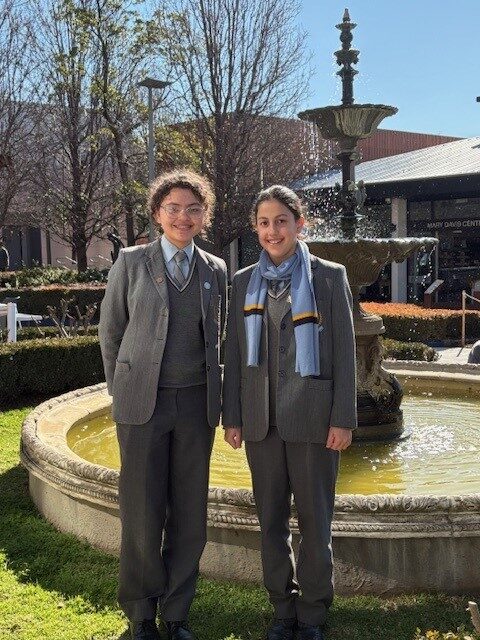
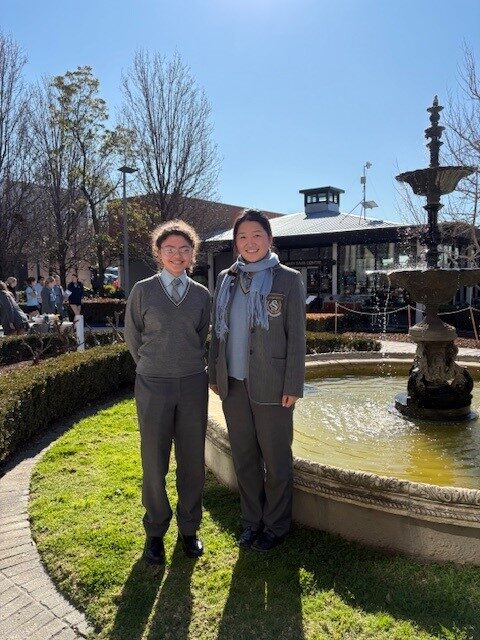
This week we received the exciting news that both Soraya and Celina had been shortlisted for the prestigious award. As part of being shortlisted, both students are invited to Oxford to the prizegiving, where they can discuss their essays with Oxford, Princeton and Cambridge Professors. They also have the opportunity to meet the admissions chairs of the departments for Oxford and Cambridge.
Below are excerpts from all three submissions:
Soraya Leos:
Writing in the Junior Category, Soraya responded to the question: Your citizenship at birth was chosen for you. Which citizenship would you have chosen?
Soraya opened her exploration with a compelling, personal comparison between her life in Australia and that of her cousin in Iran:
Today’s world is led by so-called democracies that disregard international law, and where
unjustified surprise missile attacks, genocide, and the acceptance of tyrannical regimes that
commit widespread human rights violations.
While I walk to school in Australia without fear, my cousin in Iran begins each day with panic,
surrounded by restrictions, and praying that no bomb falls on her home. If you put both our
childhood lives next to each other, you would see both girls with the same spark and knowledge,
but one will have opportunities to show her talent, and the other will likely not. Citizenship,
more than personality or potential, shaped our youth. While I grew up with rights I did not earn,
she grew up fighting for freedoms I often take for granted, which is simply a matter of luck.
Celina Wang
Writing in the Senior Category, Celina Wang chose to respond to a question from the Psychology category: What is self-deceit?
Here is her definitional ground from early in the essay:
To lie is to deliberately fabricate or distort reality to another, often exhibited when one seeks to avoid punishment, protect oneself, or gain advantage in social contexts. On the other hand, self-deceit is convincing oneself that something false is true, often to reduce psychological discomfort by preserving a positive self-image. Both serve to protect the ego, however lying is a labour of the conscious mind as it acknowledges an unwanted yet objective truth by actively reshaping it, while self-deceit is commonly the emotionally driven response of the unconscious mind in a vigorous denial of reality.
Opal Scheele
Opal also entered into the Senior Category, selecting a question from Philosophy: ‘Should we treat non-human animals well because they have rights, interests, neither, or both?’
Here is Opal’s delineation of the difference between rights and interests:
In league with the basis of animal welfare being animal rights, is animal interests. The interests of animals extend to the natural living conditions that animals are biologically built to live in as unlike humans, they do not have great aspirations and ambitious dreams of power. Animals are designed by nature to move freely in their natural habitats in the outdoors, unhindered by human activity, as they have done for centuries before human involvement. As the philosopher, Jeremy Bentham once stated, ‘the question is not, Can they reason? Nor, Can they talk? But, Can they suffer?’ Sentient beings have an interest in living an enjoyable existence without suffering and thus, animals, as sentient beings, have such an interest.
Competitions such as this encourage our students to extend themselves through engaging in deep and sustained thinking. We congratulate all three students for their submission, and wish Celina and Soraya the best of luck in the finals!