Overcoming Procrastination: Battling the Art of Delay

Are you reading this article because you are avoiding another task? Might you be enjoying the Blue Ribbon whilst knowing something else entirely needs your full attention, but just can’t bring yourself to start that yet? Have I put off writing this article for a week, even though I have been reminded of the due date twice and have had ample time to write it, but would just like to find a time where I have brain space to perfect it? If you answered yes to any of the above questions, you might consider that you are procrastinating.
What is Procrastination?
Procrastination is a common challenge facing adults and students of all ages, often turning even the simplest tasks into monumental hurdles.
Studies have shown that an estimated 20 percent of adults are chronic procrastinators (Rogowska, A. M., Cincio, A., 2024), 80 percent of college students procrastinate when completing their academic work (Gonzalez-Brignardello M. P. et al. 2023) and up to 50 percent of high school students engage in procrastination regularly (Clarina, M., 2015). Academic procrastination can lead declines in student wellbeing. It has been associated with poor academic success (Kim, K., Seo, E., 2015), emotional distress (Amani H. et al., 2021) and a deterioration of physical health (Sirois, F. M., 2023). Procrastination does not come from a place of laziness, but is a conscious effort to avoid discomfort.
Year 9 Overcoming Procrastination Workshop with Toolbox Education
Procrastination is a pertinent issue facing our Year 9s. As the end of the Semester approaches, our students’ first foray into examinations is in sight. On top of this, academic deadlines loom for everyone.
Invariably, despite the three-week break feeling almost tangible, stress mounts. Given this, understanding the roots and remedies of procrastination have become crucial for our students
Year 9s had the opportunity to work with Toolbox Education through a Workshop on Procrastination this week. Through this, students looked at the causes of procrastination, its impact on academic performance, and effective Cognitive Behavioural Therapy based strategies to help students overcome this pervasive habit, paving the way for a more productive and balanced school life.
Key to the Workshop was identifying that procrastination is an avoidant behaviour in response to a feeling of discomfort. From this, students were able to implement strategies for removing obstacles in the way of completing a task and action plan.
Strategies for Overcoming Procrastination
The strategies provided to students by Toolbox Education were:
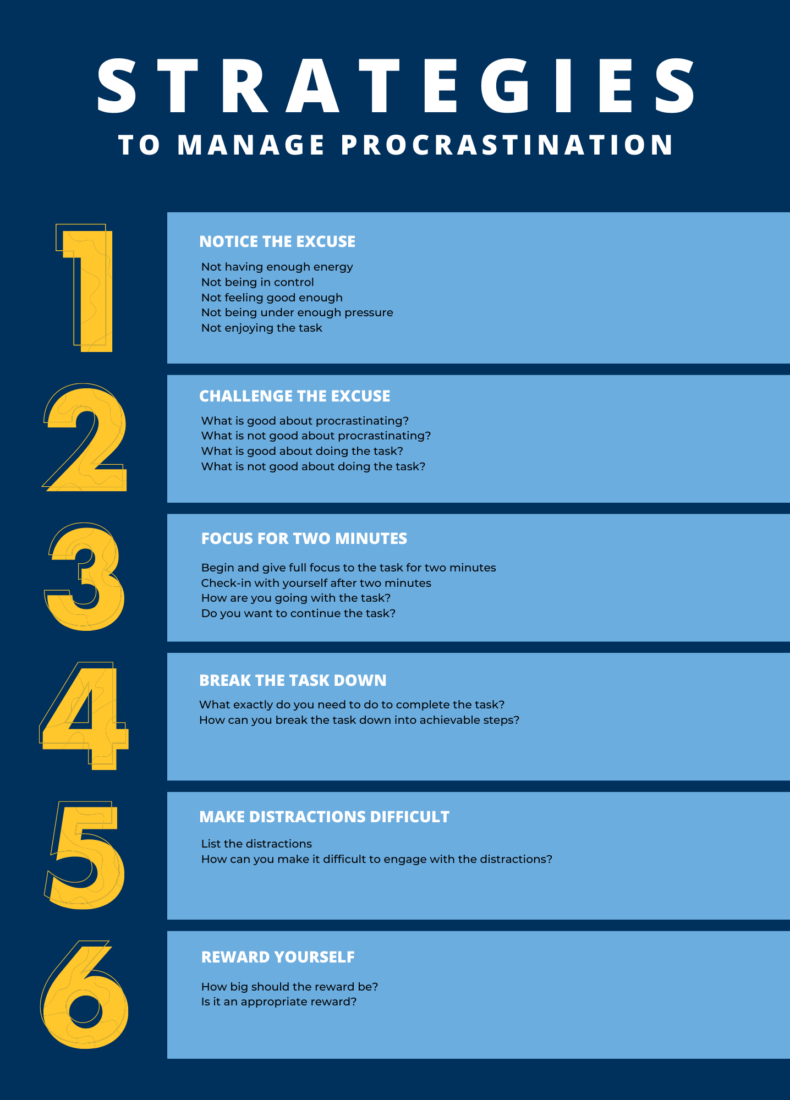
Putting It into Practice – Student Feedback
Victoria Guan, Year 9: “I think everyone struggles with procrastination as they naturally want to do what appeals to them, what they find easy, subjects they are good at. However, you need to decide where placing effort would make the most difference.
Procrastination is a difficulty we all need to overcome. I found the Workshop helpful as someone who sometimes does struggle with procrastination. Not being under pressure really resonated with me when noticing excuses, that is definitely something I have had trouble with before. I have used breaking the task down to smaller components to make the task easier. By completing each part of the task, you have a small sense of achievement which helps propel you to continue working.
After the Workshop, I particularly think the Challenge the Excuse Strategy would be useful, because you could look at the pros and cons, and it helps you make a decision about what to do.”
◊
Saskia Gelbak, Year 9: “I really found the Workshop useful. It gave me strategies that were easy to understand and implement. I totally identified with the Noticing the Excuse Strategy. I often tell myself that I don’t have enough energy to complete a task. Breaking Down the Task and Rewarding Myself are two takeaways that I have from the Workshop. Breaking it down makes it far less overwhelming and you view the task in sections. This seems a lot more achievable.”
◊
Ziabella (Zia) Armstrong, Year 9: “I actually thought that the Workshop was so useful. I felt like I related to it a lot. As much as I say I don’t want to procrastinate, I do, unfortunately. I did identify with Noticing the Excuse, not having enough energy is the main thing that stops me starting the work. Breaking it down is something I have used before, but I do forget to do it. This was a good reminder, and I think that including the Reward Yourself strategy in conjunction with this would make it more successful. These are two things I will use going forward, especially in Science and History.”
◊
Madison Grey, Year 9: “I often think I have a lot of time to do something, and before I realise it, the due date creeps up and I do not have time to complete the task and it ends up being a rush. I found the Workshop helpful because it taught me how to manage my time better. It has helped me to start a task and keep focused on it. For me, the Focus for 2 Minutes was the strategy that has helped the most. Instead of two minutes I have adapted it to 10 minutes. When I go to check in, I notice that I usually have my flow going by then and I tend to continue with the task and get the work done. It really can be just starting the task that is the hard part.”